Accountable automation starts with the exception
The most reliable AI workflows are not designed around the happy path. They are designed around what happens when the input is unusual, the confidence is low or the customer needs a person.

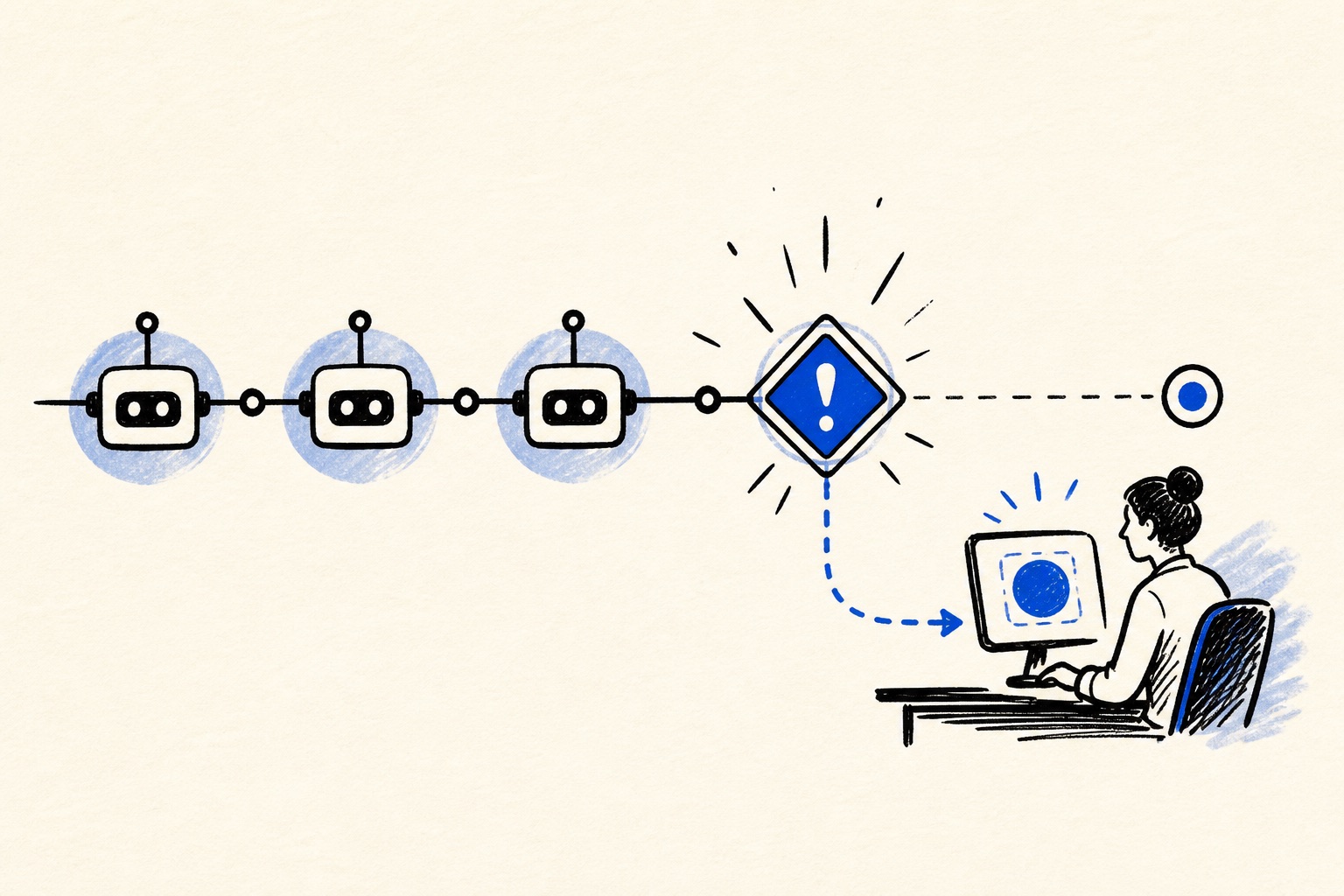
Automation projects often begin with the easiest version of the process. A request arrives, information is extracted and a task is completed. That can demonstrate value, but it does not establish whether the system is ready for the real operating environment, where requests are incomplete, customers are upset and conditions change.
The exception is where accountability becomes visible. A company that can handle unusual cases well will build more trust than one that automates a large volume of routine work while leaving people to untangle failures without context or authority.
The exception defines the real workflow
In many operations, the routine cases are not the expensive part. The expensive part is the request that arrives without a required document, the customer who needs a policy interpreted or the issue that spans two teams. An AI system should be judged by whether it makes those cases easier to identify and route, not by whether it can avoid showing them.
Teams should map exceptions before launch and assign an owner to each meaningful category. That owner needs the information, permission and time to resolve the issue. Otherwise the automation becomes a faster way to move an unresolved problem from one queue to another.
Confidence scores are not a substitute for judgment
A model may produce a score that suggests how certain it is, but the organization still has to decide what that score means in context. A low-confidence spelling correction is different from a low-confidence recommendation that affects a customer’s access to money, care or service. The risk belongs to the workflow, not the number alone.
The useful design work is to connect confidence with action. Some outputs can be accepted, some can be reviewed in batches and some should never proceed without a specialist. Those rules should be understandable to the people who operate the process, not buried inside a technical configuration.
Recovery should improve the next decision
When a person overrides an automated result, the event should not disappear. It is evidence about the system, the input or the business rule. Capturing that evidence can improve prompts, data quality, training and the decisions about where automation should be expanded or limited.
This creates a practical learning loop. The organization is not waiting for a perfect model before it deploys. It is using real operating feedback to make the system safer and more useful over time. That is a stronger model of accountability than assuming a launch decision is final.
The handoff is where automation proves its maturity
A well-designed AI workflow makes the routine case faster and the difficult case clearer. It gives the human owner enough context to act, then learns from the result. That is how automation becomes part of a reliable operating system.