AI evaluation is becoming infrastructure
The companies that can test quality, safety and product fit continuously will move faster than those that treat evaluation as a last check before launch.

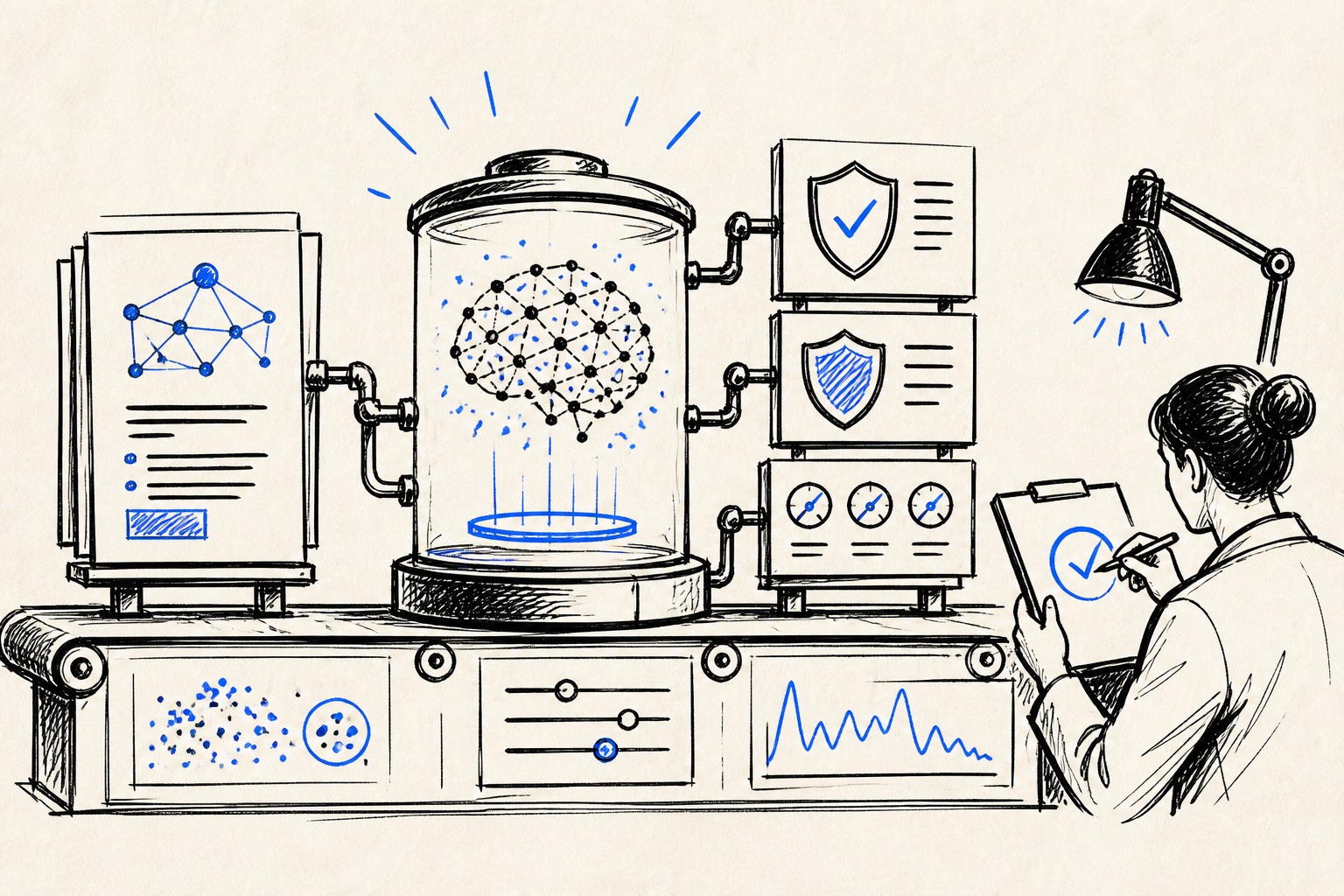
AI products do not fail in one simple way. They can be fluent but unhelpful, accurate in ordinary cases but brittle around a rare input, safe in a demonstration but poorly suited to a real customer workflow. That makes evaluation less like a scorecard and more like a permanent part of the product system.
The organizations that build this capability early will have an advantage that is easy to underestimate. They will know what their product does, what it should refuse and where human review is still necessary. That knowledge makes iteration faster because it replaces guesswork with evidence.
A benchmark is not a customer task
Public benchmarks can be useful for comparing broad model capability, but they rarely capture the full conditions of a product. A customer may use incomplete documents, industry language, unusual requests and data that changes over time. A system that performs well on a general test can still fail at the part of the workflow that matters commercially.
Product teams need their own evaluation sets built from approved, representative examples. Those sets should include the successful outcome, the risky outcome and the ambiguous case where the right behavior is to ask for help. The goal is not a perfect score. It is a reliable standard for deciding whether a change improved the service.
Quality has to include behavior under pressure
An AI system should be tested not only when the input is clean, but when the request is rushed, adversarial, incomplete or emotionally charged. These are the conditions that reveal whether a product has a useful escalation path. The evaluation should include the consequences of a wrong answer, not simply whether the text resembles an expected response.
This work benefits from people outside the model team. Customer support, compliance, domain experts and frontline users can identify the failures that a purely technical test misses. Their participation turns evaluation from an engineering gate into a shared understanding of what the product owes the people who depend on it.
Continuous evaluation supports responsible speed
Models, prompts, retrieval sources and customer behavior all change. A one-time review cannot guarantee that a product remains reliable. Continuous evaluation gives a team a way to observe performance after launch, compare versions and pause a change when the evidence is not strong enough.
That discipline can feel slower at first. In practice it prevents expensive reversals and makes the team more confident about where to deploy. The ability to test a product quickly and explain the result is one of the most important forms of infrastructure an AI company can build.
The best AI teams make quality observable
Evaluation becomes infrastructure when it is connected to product decisions, customer reality and ongoing change. It gives a company the confidence to improve quickly without asking users to discover every failure first.