Why data center land banks are becoming an AI-era asset
Land is only valuable when it can support power, fiber, permitting and an operating plan. In AI infrastructure, those conditions are becoming harder to assemble at the same time.

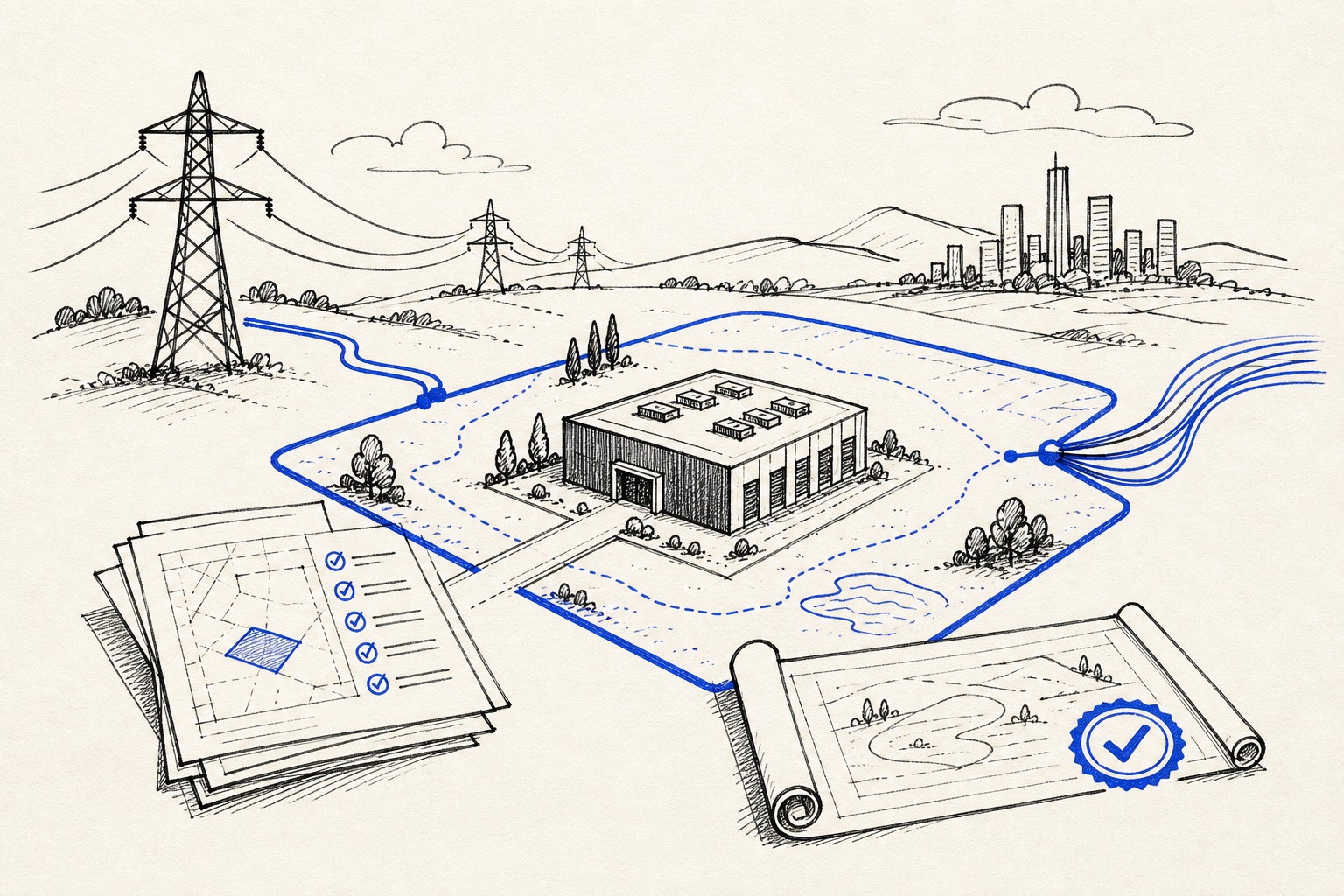
The phrase land bank can sound passive, as if a developer has simply acquired acres and is waiting for demand. In AI infrastructure, the valuable asset is more specific. It is a site where power, transmission, fiber, permits, water conditions and community relationships can plausibly support dense, reliable computing.
That distinction matters because the industry is discovering that not all available land is deployable land. The work of assembling the right site can take years, and it is increasingly tied to the physical constraints that determine whether an AI facility can ever become a useful service.
A site is a bundle of rights and relationships
Owning land does not guarantee that a data center can be built, energized or connected at the required scale. The developer needs a credible path through zoning, environmental review, grid interconnection, access roads and telecom infrastructure. Each dependency has its own timetable and its own stakeholder group.
The best land positions therefore include more than a property boundary. They include an understanding of local infrastructure plans, a relationship with the utility and a realistic view of what the community will accept. Those intangibles can be difficult to value, but they often determine whether a project moves from plan to operating asset.
Power changes the value of the map
AI rack density has made power availability a much more decisive factor in site selection. A region with attractive real estate may still be a poor choice if it cannot deliver reliable capacity in the relevant period. Conversely, a site near existing transmission or generation may become valuable even if the land itself is less convenient.
This does not mean every developer should chase the same markets. It means the analysis needs to begin with the grid, not end there. A land bank is valuable when it gives an operator options that competitors cannot quickly recreate, particularly where new transmission and substation equipment require long lead times.
Community approval is part of delivery risk
Large facilities can bring jobs, tax revenue and supporting investment, but they also raise legitimate questions about power use, water, noise and the local benefit of a project that may not employ many people after construction. Developers that treat these concerns as a late-stage communications issue can create avoidable delay.
A more durable approach is to show how the facility fits into a regional plan. That may include efficiency commitments, support for workforce training, transparent energy agreements and clear explanations of the local economic role. The project becomes easier to sustain when the community can see more than a fenced building consuming a scarce resource.
The market will separate options from inventory
As demand for AI capacity grows, more companies will describe their development pipelines in expansive terms. Investors should distinguish between inventory that is merely controlled and sites that are meaningfully advanced. The difference lies in interconnection progress, permitting status, equipment availability and customer interest.
A sophisticated land strategy can create valuable optionality. A vague collection of parcels can create a story without a timeline. The market will increasingly reward developers that explain the sequence from land control to energized capacity rather than treating all acreage as equivalent.
The valuable square foot is the one that can become reliable compute
AI has made the physical preparation behind a data center more strategically important. Land banks matter when they compress the difficult path between a promising location and an operating service that customers can trust.