5 data center trends reshaping AI economics
The cost of intelligence is increasingly determined by facility design, energy contracts and how consistently expensive equipment is used.

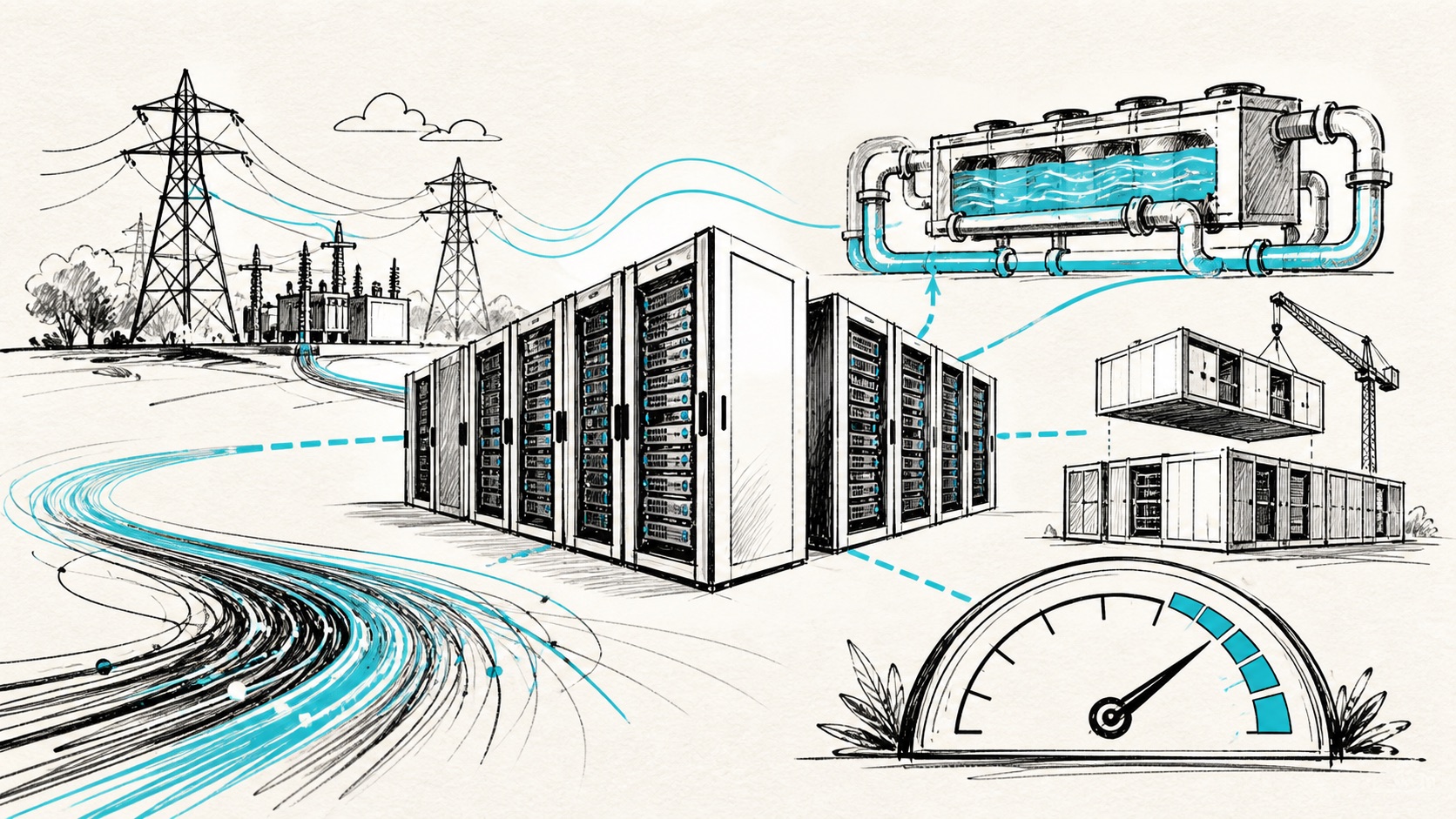
AI infrastructure is moving from a component story to a systems story. The economic advantage may sit in power sourcing, cooling, networking, construction speed or workload scheduling rather than the accelerator alone.
These trends matter because they change the cost and timing of useful capacity. Investors should connect each announcement to delivered performance.
Three tests for a useful opportunity
The indicator connects spending to utilization, margins or customer demand.
A real constraint limits supply, speed or return on invested capital.
The trend can matter beyond one model cycle or product announcement.
This ranking is an editorial framework, not a forecast or promise of financial results.
The ranking at a glance
Five practical pathsHigher rack density
More compute in each rack can improve cluster efficiency, but it raises the demands on power distribution and heat removal. Existing facilities may require significant retrofits to support the new profile.
Quoted rack capacity does not show how much of the room can run at that density.
Liquid cooling adoption
Direct-to-chip and immersion approaches can support dense workloads that air cooling cannot handle efficiently. The transition creates demand for new components, operating skills and maintenance procedures.
Total facility efficiency includes pumps, water treatment and downtime procedures.
Modular capacity expansion
Standardized modules can bring smaller increments of capacity online while larger campuses continue to develop. The model can reduce schedule risk when demand timing remains uncertain.
Repeatability depends on local permitting, power and supply availability.
Long-term energy contracting
Operators increasingly need energy visibility that matches the life of the facility. Contract structure, grid congestion and backup requirements can shape margin for years.
Headline renewable supply should be compared with hourly consumption and local constraints.
Workload-aware operations
Scheduling flexible work around power, cooling and network conditions can improve the output of installed assets. Software and facility operations begin to share one optimization problem.
Efficiency should not compromise service commitments or data residency.
Treat the facility as part of the computing product
The winning operator will connect silicon, power, cooling, networking and scheduling into one measurable cost per useful workload.
Get the free 25 AI Offers field guide.
Practical starting points, buyer problems and offer angles for the AI economy. Download it now and get the next useful briefing.