Latency is now an AI product decision
Response time shapes what customers will delegate to a system, what a human will tolerate during work and which model architecture makes commercial sense.

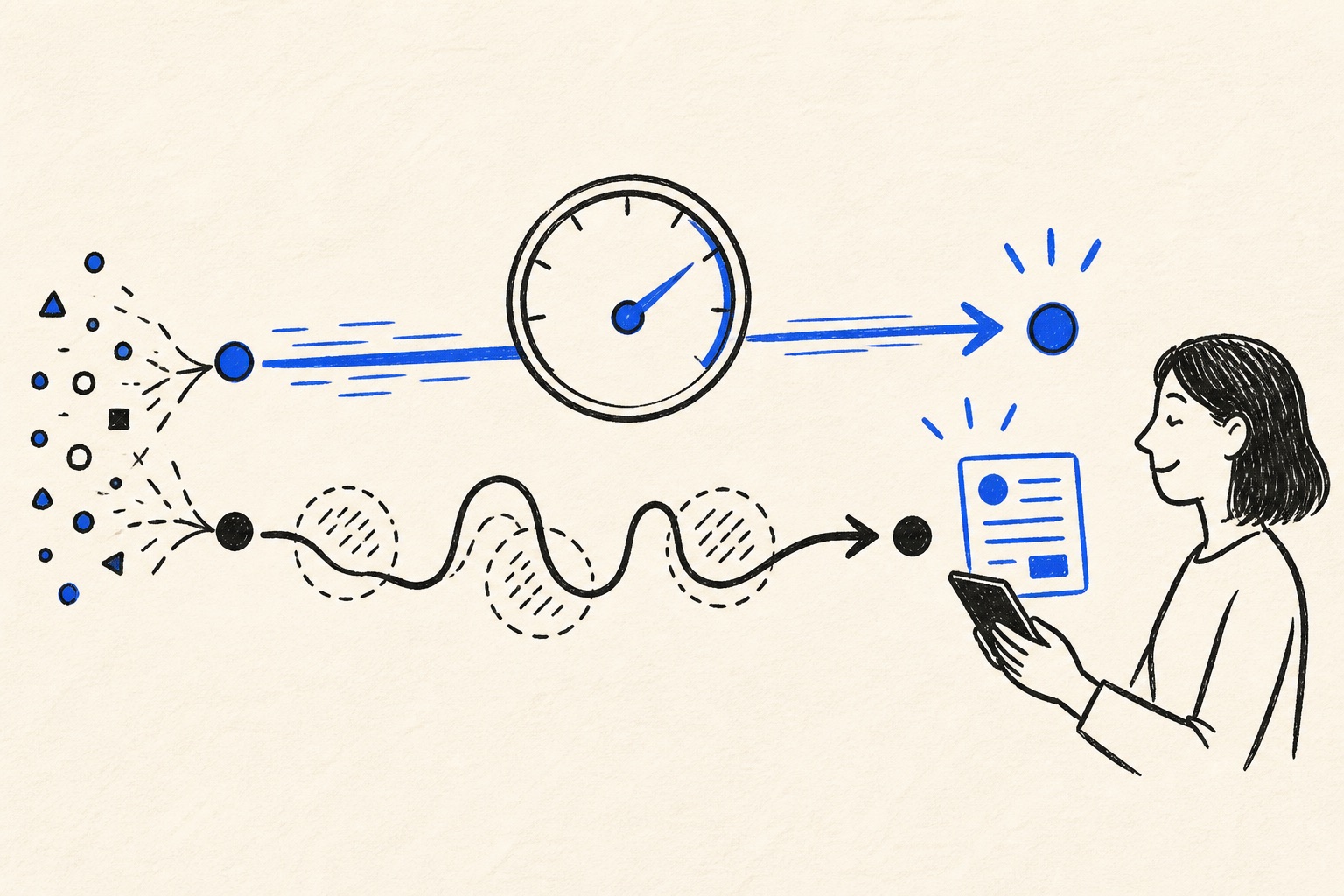
AI products often begin with an assumption that users will wait because the capability is novel. That patience disappears once the system becomes part of a normal workflow. A response that is acceptable for a research task may be unusable for a customer conversation, a live support interaction or a worker trying to complete a routine action.
Latency is therefore not only an engineering metric. It is a product decision about what the system is allowed to do, when a user should remain in the loop and how a company designs the experience around the time required to produce a useful result.
Different jobs deserve different response expectations
A system that prepares a detailed analysis can reasonably take longer than one that helps a customer find an account status. Treating every AI interaction as a real-time conversation can create unnecessary infrastructure cost and pressure teams to use an unsuitable model. The right expectation begins with the job and the user’s tolerance for delay.
Product teams should make that expectation explicit. A queued task can be presented as a task, with a clear status and a useful notification when it is ready. A live interaction should be designed around a response time that does not make the user wonder whether the system failed. Clarity can be as important as speed.
Architecture choices become visible in the experience
Caching, smaller models, retrieval design, regional deployment and streaming responses can all improve perceived or actual latency. Each choice also affects cost, complexity and sometimes quality. The product team needs to decide which tradeoff serves the customer rather than asking infrastructure teams to make every delay disappear at any price.
This is where a good service level becomes useful. It defines what a customer can expect for a given task and gives the company a way to measure whether the system is meeting its promise. A vague commitment to fast AI is difficult to operate. A clear response standard can guide both engineering and commercial decisions.
Waiting time changes the human role
When a system responds slowly, people invent their own workarounds. They may start a task in another tool, duplicate a request or abandon the workflow altogether. Those behaviors can make a product look less useful even if its eventual output is strong. The design needs to account for what the person can do while they wait.
Some workflows benefit from an asynchronous model where a human can continue other work and return to a prepared result. Others need an immediate acknowledgment and a quick human fallback. The lesson is simple: time is part of the experience, and a product that ignores it is asking users to absorb an invisible operating cost.
Fast enough is a product promise, not a benchmark score
AI systems will be judged by the pace of the work they enable. Companies that match latency to the job, communicate expectations and design useful handoffs will create more dependable products than those that treat speed as a technical afterthought.