5 private AI opportunities in regulated industries
The market for private AI is growing wherever useful context cannot be casually sent to a shared external service.

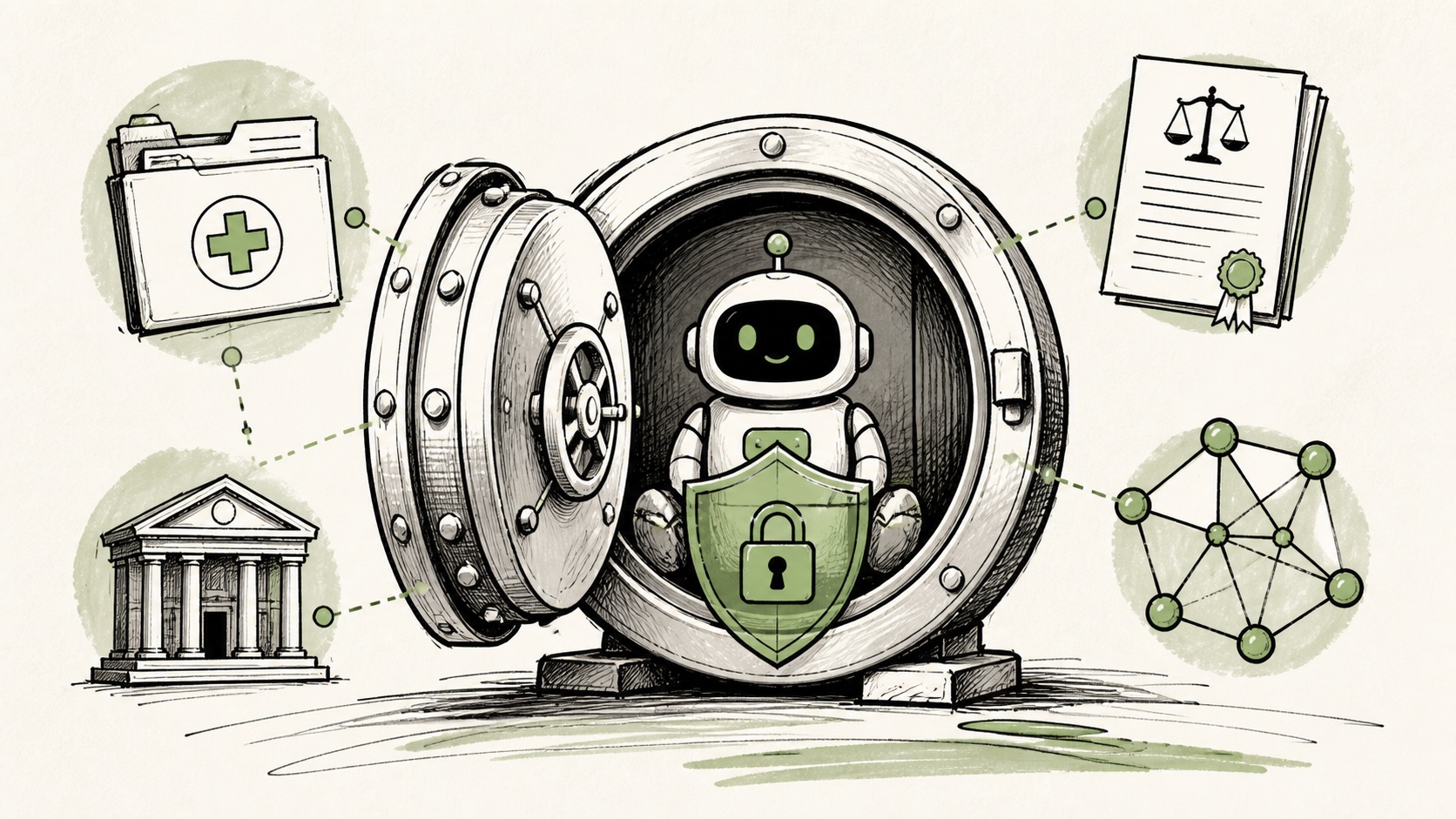
Private AI is not one architecture. It is a set of choices about where data moves, who can access it, how outputs are logged and which models are permitted for each task.
We ranked the opportunities where privacy is part of the product value, not merely a procurement hurdle. Each one rewards providers that can explain controls as clearly as capabilities.
Three tests for a useful opportunity
The system is strong enough for the job without paying for unnecessary capacity.
Security, latency and maintenance are practical for the intended operator.
The advantage grows through data, workflow depth, distribution or trust.
This ranking is an editorial framework, not a forecast or promise of financial results.
The ranking at a glance
Five practical pathsConfidential document search
Legal, financial and health teams need faster access to internal knowledge without exposing every document to a general service. Permission-aware retrieval can deliver value while respecting existing access boundaries.
Retrieval must enforce document permissions before any model sees the content.
On-premise transcription
Meetings, interviews and field recordings often contain sensitive details. Local transcription and summarization can reduce exposure while making the material searchable and easier to review.
Retention policies should cover audio, transcripts and derived summaries.
Private code assistance
Software teams in regulated environments want assistance without sending proprietary repositories outside approved infrastructure. A smaller private model can support explanation, test generation and internal patterns.
Generated code still requires security review and repository controls.
Secure case summarization
Analysts and case workers spend time assembling timelines from approved records. A private system can prepare a draft chronology and identify missing evidence for a human reviewer.
The interface must distinguish source facts from generated interpretation.
Policy-constrained drafting
Teams can generate routine communications against an approved policy library and block unsupported language before release. The system becomes a controlled drafting environment rather than an open-ended chatbot.
Policy updates need an owner, effective date and audit trail.
Privacy must be visible in the operating model
A private deployment is credible when the buyer can see the data boundary, permission model, logging policy and fallback process. Architecture alone does not create trust.
Get the free 25 AI Offers field guide.
Practical starting points, buyer problems and offer angles for the AI economy. Download it now and get the next useful briefing.