AI scaffolding can help people learn without pretending the work is done
The most useful learning tools do not merely provide an answer. They help a person understand the next step, test their reasoning and build confidence that can survive outside the interface.

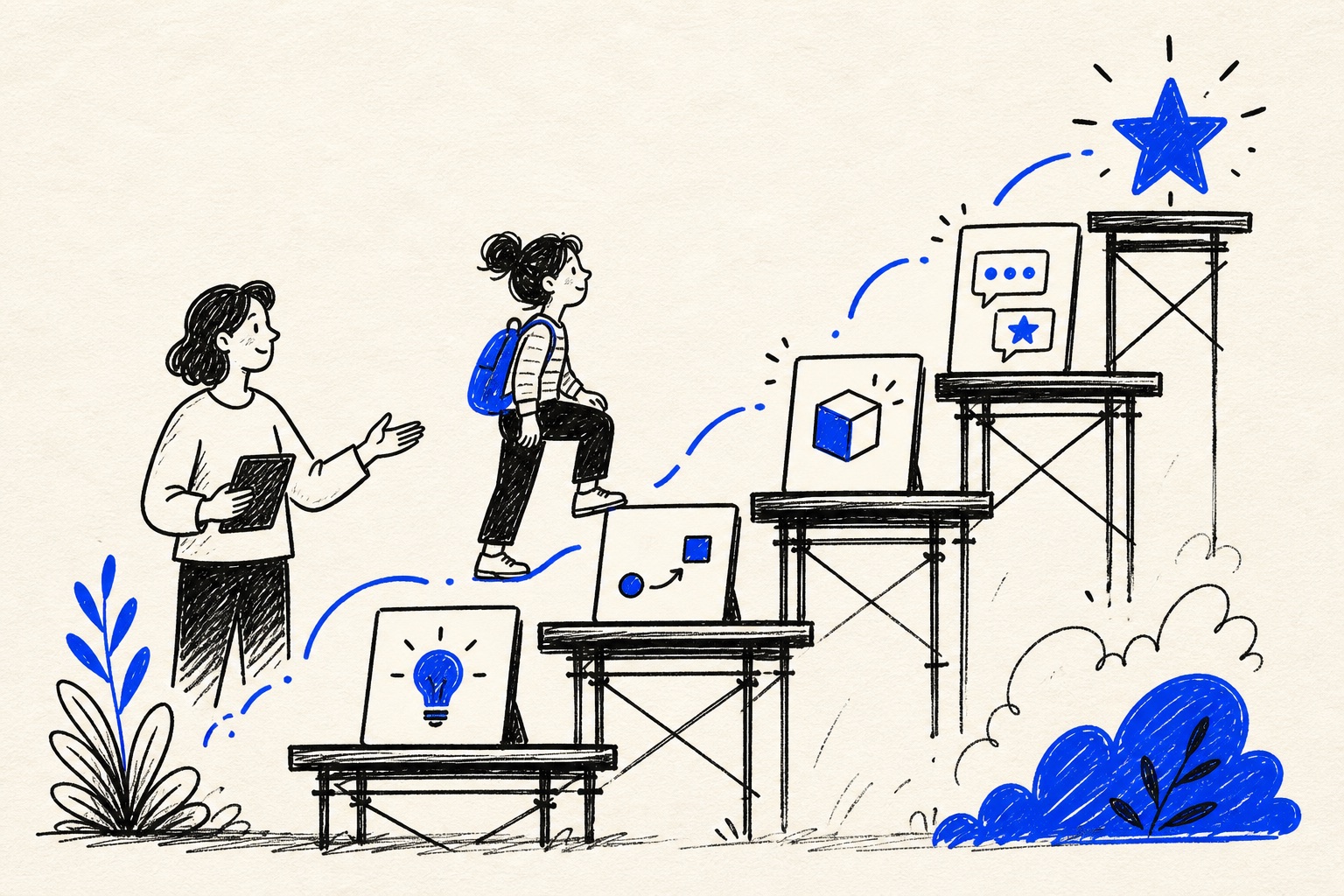
AI can make learning feel easier because it can explain a concept in several ways, provide examples and respond to a beginner’s question without impatience. That is a real opportunity. It becomes less useful when the system gives the finished answer so quickly that the learner never develops the ability to recognize or reproduce the reasoning.
The design challenge is to use AI as scaffolding. A good scaffold supports someone while they gain a skill, then becomes less necessary as the person can act independently.
Hints can be more valuable than solutions
A learner often needs help identifying the next move, not the entire result. An AI tutor can ask a clarifying question, point to a relevant principle or show a comparable example. This keeps the person engaged with the reasoning and gives them a chance to practice the part of the task that will matter later.
The product should make it easy to request more support when needed, but it should not assume that the fastest answer is always the best educational outcome. The right level of assistance depends on the learner’s experience, the stakes of the task and the goal of the exercise.
Feedback needs to be specific and honest
Generic praise can make a learner feel supported without telling them what to improve. Useful feedback identifies the strength of an approach, the point where it lost precision and the evidence that would make it more convincing. AI can help provide this feedback at scale if the product is designed around clear standards.
The system also needs to recognize uncertainty. It should not confidently teach a flawed method or invent a rule when it lacks evidence. Learning tools earn trust when they show sources, invite verification and encourage the learner to question an answer that does not fit the problem.
Learning should remain connected to real practice
A person gains confidence when they can apply a concept to their own work and receive feedback on the result. AI can make that practice more accessible by creating scenarios, comparing drafts and helping someone reflect on a decision. It cannot replace the experience of using a skill in the conditions where it will actually matter.
Organizations using AI for training should therefore connect the tool to mentorship, real assignments and a clear standard of performance. The technology can support repetition and preparation. The workplace still needs to provide responsibility, context and human guidance.
The right AI tutor leaves the learner more capable without it
Scaffolding works when it helps a person take the next step, understand the reasoning and practice in context. AI can widen access to that support while preserving the effort through which real skill is built.