Process redesign has to come before the AI tool rollout
A weak process does not become strong because a model can generate faster text. It often becomes harder to understand, because the old problems now move through the system at greater speed.

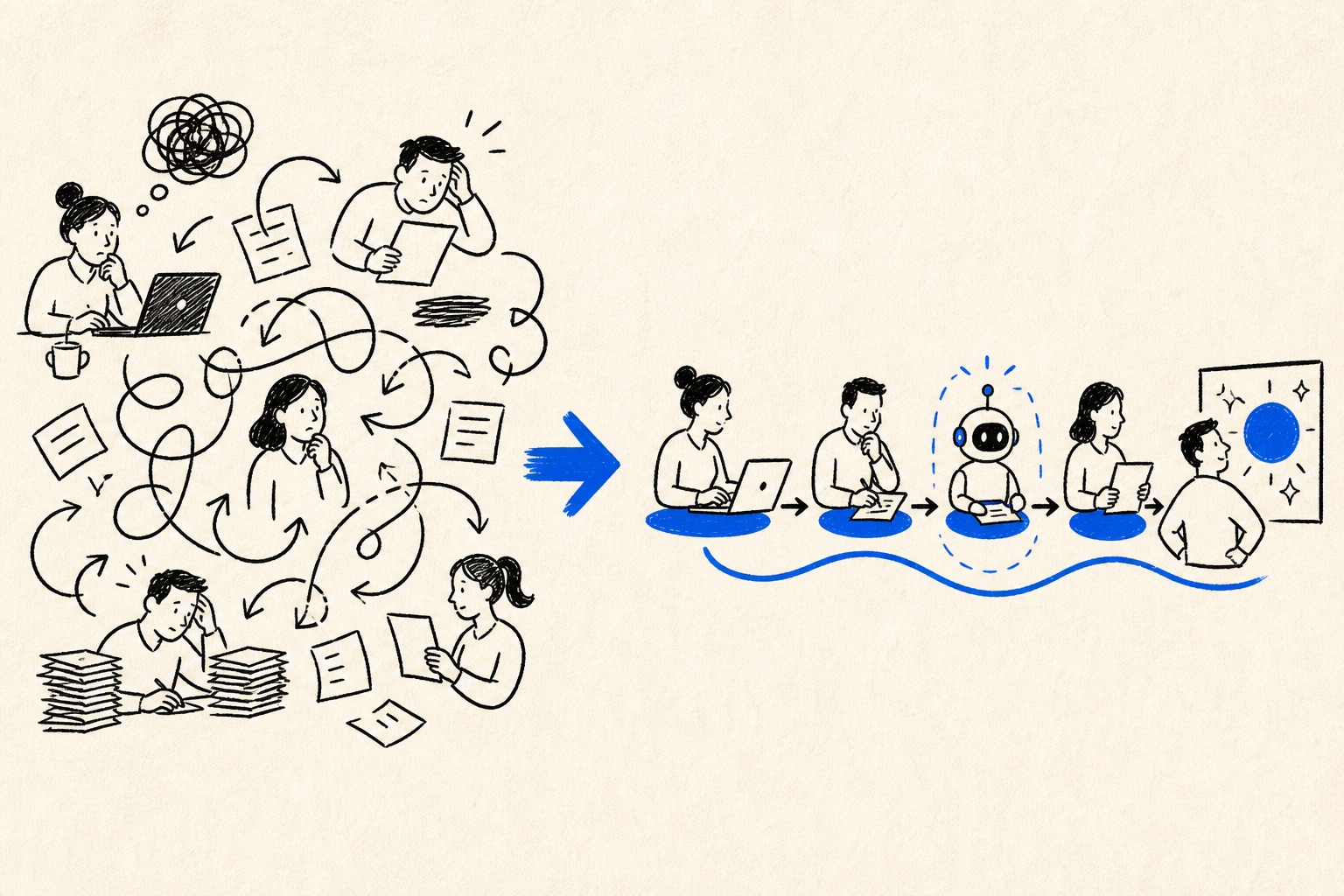
Organizations often introduce AI at the point where work is most visible: drafting, responding, summarizing or classifying. That can create a quick improvement. It can also hide the upstream issues that make the process slow or unreliable in the first place, such as unclear ownership, duplicate data or a decision that nobody has defined.
The best AI deployments treat the tool as an opportunity to redesign the process around a clearer result. The question is not how to insert generation into the old workflow. It is how to remove waste, make decisions more legible and give people a better handoff.
Map the work before optimizing it
A process map does not need to be elaborate. It needs to show what triggers the work, which information enters, where decisions happen and what counts as complete. This simple exercise often reveals that the task being targeted by AI is downstream from a more basic problem, such as missing intake data or an approval loop that nobody owns.
Once the map is visible, a team can decide where AI belongs. It may prepare a draft, identify a missing field or route an exception. The important point is that the design follows the actual work rather than a product feature the organization is trying to justify.
The new workflow needs a clear human role
AI can compress some steps, but it does not remove responsibility for the result. A person or team still needs to decide when the output is accepted, when it requires review and what happens when the case falls outside the normal pattern. These roles should be established before launch, not discovered when a customer or regulator asks who approved an action.
This clarity also helps employees adopt the system. People are more likely to use a tool when they understand how it changes their job and where their judgment remains valuable. A rollout framed as replacement or vague efficiency can create defensive behavior that undermines the result.
Redesign creates metrics worth measuring
A reworked process gives the organization a better way to judge success. It can measure completion time, quality, rework, escalation and customer impact rather than counting how often a model was called. Those outcomes make it easier to decide whether the deployment should expand, pause or change direction.
The discipline is valuable even when AI is not the answer. Sometimes the map reveals that a simpler rule, better data form or clearer ownership would solve much of the problem. That is a useful result. Technology should earn its complexity by improving a real operating outcome.
AI works best inside a process someone has deliberately designed
The tool can accelerate a strong workflow and expose a weak one. Companies that redesign the work first will create clearer roles, better metrics and more durable value from the technology they choose to deploy.